

How to Avoid Online Marketing Scams – Top 8 Common Traps
As online marketing industry continues to grow, there are more and more training, courses and platforms teaching people how to make money online.
However, there are simply too many of them and many people are unable to differentiate the legitimate ones from the scams. This is NOT totally your fault!
I must agree that online marketing scams have evolved to the point that experienced marketers are able to develop a very professional and legitimate-looking product to sneakily take advantage of beginners and scam their money.
It's a lot harder to identify a scam today than in the past.
In this post, I've compiled a list of 8 most common tricks scammers use so that you can be aware of it next time when you encounter it.
In addition to just revealing the common traps, I've also compiled for you 6 tips to avoid online marketing scams.
More...
The 8 Most Common Traps Revealed
#1 Many Upsells
Whenever you are deciding to join any programs or training, do some research to know whether there are any upsells.
Most online marketing scams have multiple upsells because that's one of the best ways for the creator of the products to make more money from each of the customer.
Having many upsells is like getting part of the puzzle at a time, not the entire thing. In order for you to understand the complete puzzle, you must keep on paying more and more for each piece of the puzzle.

Image source: PhelpsWi.us
Let me tell you, the mindset of people who creates many upsells is mainly to make money for themselves. They are not focusing on truly helping people. They just want to earn more money.
So, what could you expect from their products?
Instead of creating one quality product that includes everything, they are selling 4-5 lower quality products/services that makes up something decent.
On the other hand, legitimate business owners put their priority at helping people and creating values. They don't believe in having many upsells. Since they want to help people, they will simply provide their customers with the full puzzle at one price.
In my first online venture, I was in a scammy company trying to learn from their training. Since I was just starting out, I fell into their traps.
I was paying up to the second layer upsell every month. Eventually, I found out there were more than 4 upsells waiting for me. And the ultimate upsell costs like $20,000. That's ridiculous!
In a recent scam review I've done, they offer you the upsell immediately after you purchase their first product. It just shows how eager they are to take your money!
Just know that if you encounter something similar, stay away from it.
#2 Empty Promises
"Earn $1000 by the end of the week with this proven system", "Make a full-time income online in a month just by following this simple trick", "You don't have to do anything and your business will run on autopilot"...
Familiar with these sales pitches?
This type of empty promises can be easily identified by experienced marketers. However, beginners are prone to fall for these traps especially when they are very eager to earn money.
That's why scammy marketers are still using this kind of empty promises to scam beginners' hard earned money.

Image source: Northman Trader
The reason why these are empty promises because these are all untrue and mostly impossible for beginners. They are just using some copy writing techniques to attract people's attention and spark beginners' interest.
Let me tell you honestly as an experienced marketer, making money online is NOT EASY! It's really not easy.
It often takes months or even up to a year or two of consistent learning and practicing before one could make a full-time income online. You can ask any sincere experienced marketer and they will tell you the same.
So, do you still believe in those empty promises?
#3 Contradicting Information
If the creator of the product is focusing on his own earnings, then he will tend to have salesy pitches, just like in the previous point, to attract people.
This will often lead to another problem of contradicting information because he wants to sound legitimate when it's not.

Let me give you an example...
In the Internet Jetset review, the creator John pitches that people can make their first commission within 2 hours after joining his program. Really scammy, isn't it?

John Crestani's follow-up sequences are full of "salesy" Emails
However, in his introductory webinar, he said that "This is not a 'get rich quick' scheme...". Isn't that contradicting? Isn't he eating his own words?
This is the consequences of trying to pitch something legit while it is a scam!
If you are cautious enough, you are able to discover all these small information to prove that it is a scam.
#4 Lavish Pictures
There's a saying that goes like this:

If you have been searching about "how to make money online", you've probably come across some promotional advertisements that feature the flashy sports cars, luxurious mansions and lifestyle of someone.
And that person wants to show off his or her lifestyle in order to attract you and make money from you. This trick is very common and I've been seeing them all around the Internet.
Let me tell you, a true quality product doesn't use this method to promote because it just makes it more like a scam.
If the product is really that good, it will focus on his features and benefits, instead of using this kind of vague promotional method.
Next time when you encounter similar promotional skill, it is a sign to you that it's probably a scam!
#5 Outcome Focused - Full of Hype!

Image source: The Huffington Post
In online marketing business, it's easy to attract people by showing the outcome of a certain product or training.
Many people like to show screenshots after screenshots of their paycheck or their income report. Another common way is to have a lot of hype about how the person's life have changed dramatically because of this product.
While it is good to have some proof, having too many of them is also a sign of a scam. After all, the owner's "Life Transformation Tale" is irrelevant to YOUR SUCCESS.
A legitimate product should focus on its features, how it can benefit people and what people can learn from it, things like that. It should be focusing on how its audience like YOU can benefit from the product. A good marketer would know that he should not be focusing on ME, ME, ME...
Having some proof of the outcome is secondary. It should not be the main focus because knowing so much about other people's success story doesn't help you to be like them. What you should know is HOW to be like them.
It should be secondary also because this kind of proof may not be 100% trustworthy. It's easy to fake something like this just to attract people.
So, being too outcome focused is another sign of a scam because the marketer just wants to attract you and probably the product itself doesn't have much benefit to mention about. Who knows?
#6 High Ticket Programs
Charging customers a lot for something doesn't make it a scam. But, charging a lot of money by taking advantage of people's lack of knowledge and information is.
There's always information gaps and imperfect information in the world regardless of which market or industry. Experts like to take advantage of this and ask for a huge amount of money for this information.
In fact, most of the information can be found online for FREE in today's digital world. The problem is just where the information is.
Experienced marketers have the knowledge and take this advantage to claim that you can only learnt from their products or you can benefit most from their products. So they charge a high premium price.
Another way of looking at this is that there are many companies claiming the only way to build a really successful business is by selling LESS products at a much HIGHER PRICE.
The logic is that it is much easier to get 10 people to buy something at $1,000 than getting 1,000 people to buy something at $10. This is not always true.
In fact, this allows them to set a much higher price and handle less complaints and customer service.
At the end of the day, you won't be getting more value and benefits by spending 10X more than the initial value.
Some of the most common high ticket programs are:
- High Ticket Mentoring
- High Ticket Mastermind
- High Ticket Courses
- High Ticket Conference

Get rid of the mindset that because you are paying a lot for something, it is going to be of a high value and quality. It's the opposite way most of the time.
You are most probably being scammed if you are paying thousands of dollars for information products when it can be learnt online at absolutely no cost.
#7 Pyramid Scheme
A pyramid scheme is a business model that recruits members via a promise of payments or services for enrolling others into the scheme, rather than supplying investments or sale of products or services.
Basically, this is a type of program which you are taught on how to bring in more people into the scheme but you can't learn how to sell any other products. Your only income is from inviting more people to join the scheme.

Image source: Broken Secrets
Pyramid schemes are unsustainable and often illegal but in the online marketing world, there are often other types of programs that are pyramid scheme in disguise.
During my first online venture, I joined a pyramid disguised program which I was taught how to build website and bring in more members for that program. I wasn't able to learn the proper knowledge of online marketing on how to market real products and services to my target audience.
Until one day someone told me about that program being an illegal pyramid scheme, then I realize that it is somewhat a scam.
So, always beware of similar types of programs that may be a pyramid scheme in disguise.
#8 Limited (Time) Offer
This is a technique that marketers use to boost sales by imposing some invisible force - limited time offer or limited availability.
If you are a businessman, you know this very clear that it's just a way to sell more in a short period of time and earn more money.
While having a limited (time) offer doesn't make the product a scam, it's a technique many scammers use to boost sales for their low quality scammy products.
It's just a sign for you to consider in addition to all other signs of a scam.

6 Tips to Avoid Online Marketing Scams
1. Look for Reviews Online
The first step when you encounter an online marketing program is to do a Google search on relevant reviews.
For example:
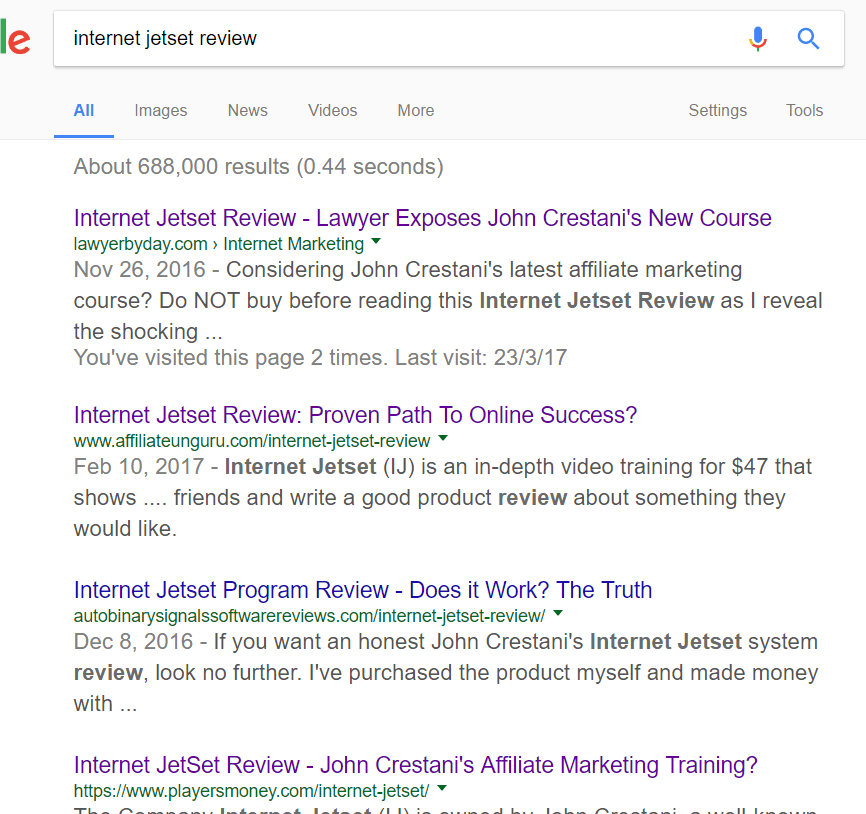
Do a simple Google Search to learn more about the program
There will probably be a couple of thorough reviews on the program or product you are looking for.
Different people have different opinion and hence a different review. Spend some time going through as many of them as possible to have a balanced perspective.
Don't trust the product sales page or the company website too much at first because they will definitely mention their benefits only. That's why you need to look for reviews done by past users/customers.
2. Use Google Suggest
This is a technique to supplement your research on the particular product.
You simply type in Google the name of the product and wait for a second. Google will show you the suggested search terms.

In addition to this, there's a technique called the "alphabet soup technique". This means that you type in any alphabet after the name of the product and see what Google suggests you to search.

E.g. Type in alphabet "a"

E.g. Type in alphabet "b"

E.g. Type in alphabet "s"
Using this alphabet soup technique, you will be able to do some further research. For example in the images above, "six figure mentors business model", "six figure mentors scam", "six figure mentors success stories", "six figure mentors money back guarantee"...
All these are good research for you to have a full understanding of the product/program to determine whether it is a scam.
3. Avoid No Free Trials
Offering a free trial allows people to take a closer look at the program to see if the program is for them. If the owner is confident in his own program, then he should offer a free trial.
Scammer definitely won't offer a free trial because they are afraid people will leave. This is a simple concept. If there's no free trial, it means that there are something hidden which the owner do not want you to know unless you pay.
So, if a program has no free trial, avoid it at all cost!
4. Don't Fully Trust Testimonials & Social Proof
Majority of the products and programs out there are backed by testimonials and social proof. This is to show some authority and build trust in its prospects.

Image source: Fully Completely Inc.
I am not saying they are all fake but just keep in mind that this kind of proof can be made up. They may not be totally true.
Don't rely too much on such proof. Instead, online reviews tend to be more trustworthy.
P.S. The testimonials on the sales page or the company website has not much value because they will definitely put those positive testimonials. If the testimonial is found elsewhere, it may be more trustworthy.
Just look at the more balanced and objective reviews/testimonials and beware of those extreme ones.
5. Beware of Money Back Guarantee
I'm not saying money back guarantee is bad but having a money back guarantee does not guarantee it is a legitimate program.
It is a psychology game that they are playing to encourage you to purchase first and see whether it is for you (especially if there is no free trial).

Guess what?! Even if it's a low quality program or a scam, not everyone who purchased it (because they are persuaded by the money back guarantee) will request for a refund. Despite it is a low quality program, they are still able to earn money as long as they get people to pay them first.
This is just something to take note when you are making a decision.
6. Follow Your Intuition!
Finally, the advice I want to give you is just to follow your own instinct and intuition. If you feel something is not right or something is too good to be true, stay away from it and do a thorough research on it if you want.
A truly sincere and quality program/product should not let you have the bad feeling.
Conclusion
It's inevitable for anyone to encounter scams online in today's digital world. The tricks that scammers use are constantly innovating as well.
This list is by all means inexhaustive. But I hope by compiling all the common traps, I can help more people to avoid online marketing scams and save their hard earned money from going to the scammers.
If you find this list helpful, please share it to help others as well.
Also, if you have any thoughts or questions on any of the things I've talked about today, leave a comment below and we'll discuss!
I've just given you the tips to avoid online marketing scams...
It's time for me to share with you something LEGIT
Take Your FREE 8-Day Email Course to discover the Best Online Business Opportunity & Learn How to Get Started for FREE!


